The MedTech founder story playbook.
A step-by-step method for extracting the story that sells your device, and mapping it across every stage of the sales cycle.
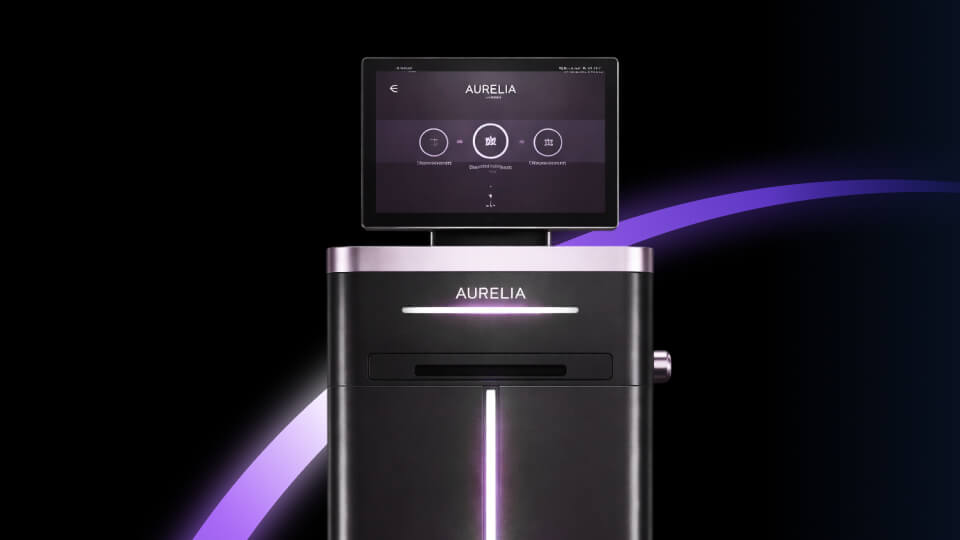
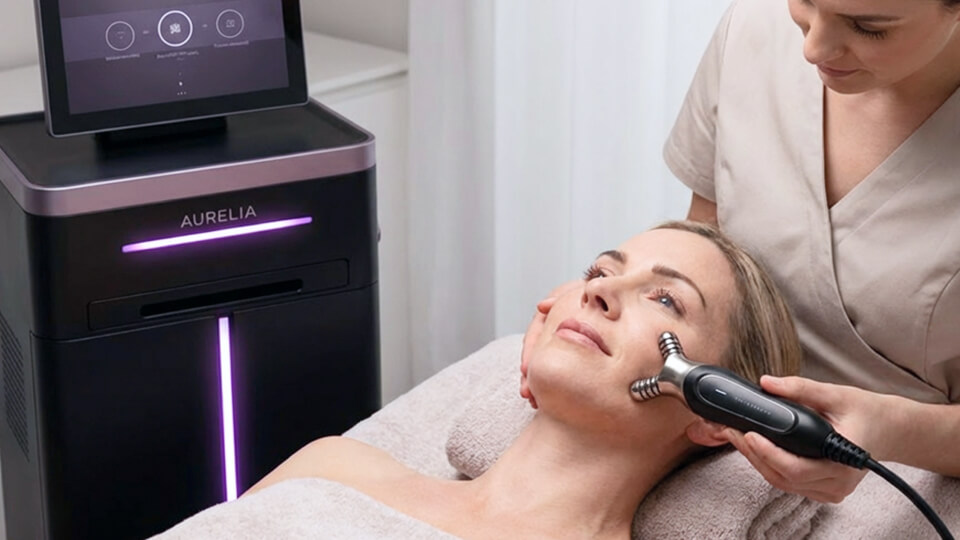
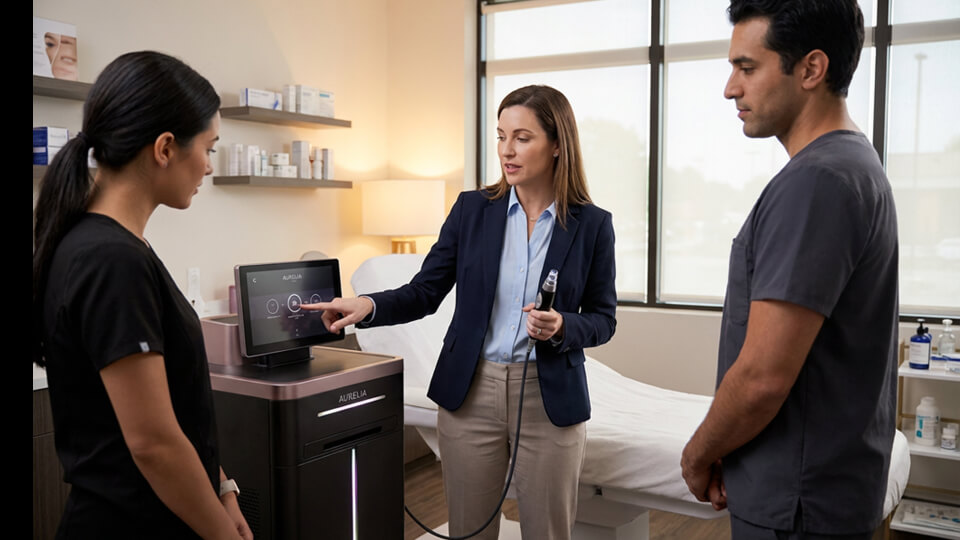
Every MedTech founder we sit with has a story. Almost none of them have extracted it, sharpened it, and turned it into the foundation of how their company sells.
This playbook is the framework we use when we do that work, a method for sharpening the founder's story into a canon, and then building every piece of sales content off that canon. The deck, the mechanism-of-action animation, the sales sheets, the website, the rep talk tracks, the cold outreach, the conference booth. The canon is the spine. The content stack is how the story actually reaches a buyer.
You can run it yourself. You can run it with a partner. You can read it and decide it's not worth doing alone. All three outcomes are useful.
01
Prepare the interview
The whole playbook turns on a single hour of conversation. Most of the work is making sure that hour is run by the right person, in the right room, with the right preparation.
Who runs the interview
The interviewer must be someone outside the founder's daily orbit. Not the co-founder. Not the head of marketing. Not the agency partner the founder has been working with for two years. Familiarity is the enemy here, the people who already know the answers don't push for the better version.
The right interviewer is someone the founder respects but doesn't have a reflexive shorthand with. An outside agency, a peer founder from a different category, a strategist on a short engagement. Their job is to ask questions the founder hasn't been asked before, in a way that requires real answers.
Setup
This can happen in person or over Zoom, same outcome either way. No film crew, no studio, no budget. Most founders over-estimate what's required. Down-and-dirty is fine.
Quiet room. Phones away. If it's a video call, do what you reasonably can to look and sound good on camera, decent lighting, a clean background, a half-decent mic on both ends. None of it has to be perfect; it just has to not get in the way.
Block ninety minutes. Sixty is the floor, anything shorter and you don't get past the rehearsed material.
Record the conversation. Most video tools do this automatically; in person, a phone on the table works. The whole playbook depends on the audio being clean enough to mine afterward.
What the founder should do to prepare
Nothing. Truly nothing. No rehearsing, no scripting their answers, no rereading their own pitch deck the night before. The whole point is to surface what they say when they aren't performing. Founders who prep over-deliver the polished version and the playbook gets less raw material to work with.
Tell them: clear your calendar, get a good night's sleep, show up willing to talk.
What the interviewer should do to prepare
Read everything public. The website, the deck if you've been given one, any podcast appearances, the founder's LinkedIn, any clinical papers. Build a mental map of what the founder says when they're being official.
Then write down three to five hypotheses about what's missing from the official story. Where does the deck get vague? What's the problem framed in the abstract that probably has a concrete origin? Those hypotheses are what you'll quietly steer toward in the interview.
02
Run the interview
Four question arcs, asked in this order. The earlier arcs surface the raw material. The later arcs sharpen it. Don't skip ahead, the order matters more than the specific questions.
Below are the four question arcs we run, in order. Ask them as conversation, not as a checklist. The questions are written to be said out loud, adapt the phrasing to how you actually talk.
- Walk me through the moment you decided this needed to exist.
- Where were you? Who were you with? What were you doing right before?
- What did you see that you couldn't unsee?
- When did "this is a problem" turn into "I have to be the one to fix it"?
- If you'd been somewhere else that day, would this company exist?
- What did the smart people in your life tell you wouldn't work?
- What did you almost give up on, and what made you keep going?
- What did you have to walk away from to build this?
- Who's the person whose "no" hurt the most?
- What does it cost you, personally, that this exists?
- Describe this problem the way you'd describe it to a clinician at a conference bar.
- Describe it the way you'd describe it to a hospital administrator with no clinical background.
- Describe it the way you'd describe it to a patient who just had a bad outcome because of it.
- What's the single worst version of this problem you've personally witnessed?
- If nothing changed, what does this problem cost the field in five years?
- Why couldn't a bigger, better-funded company have built this?
- What's the version of this device that doesn't work, and why doesn't it?
- What did existing solutions get wrong, and why didn't anyone fix it sooner?
- What's the thing only your team, this team, these people, could have built?
- What's the sentence a buyer would repeat to their boss after meeting you?
Rules for the interviewer
Don't fill silence. Founders fill silence with their best material. The five seconds after a founder answers are more valuable than the answer itself.
If they drift into spec talk, gently steer back. "That's helpful, and before you got there, what was the moment that made you certain?" works almost every time.
The most valuable thing you'll say is "say more about that." Use it constantly. Especially on the answers that seemed throwaway.
Don't take notes during. Eye contact and listening matter more than capture. The recording is doing that job. Take notes only after the founder leaves the room, first impressions while they're still fresh.
03
Mine the transcript
The interview is now a 12,000-word transcript. Eight to twelve lines inside it will become the foundation of everything you build downstream. AI finds most of them, your job is to direct it well, and to catch the lines it misses.
Mine it with AI
You don't have to read 12,000 words line by line.
Modern LLMs, Claude, ChatGPT, anything decent, are excellent at scanning a transcript and surfacing candidate lines faster than any human can. Use them, openly. There's no purity prize for doing the reading by hand.
What AI is not as good at: catching the reluctant lines, half-finished sentences, qualifying clauses, things the founder said with a slight hesitation. Those are often the truest moments in the transcript, and models tend to smooth them over. After running the prompts, do one slow read yourself with AI's candidates in hand, marking anything that sounds like the founder almost didn't say it.
The workflow: paste the transcript into your tool of choice, run these prompts in order, ask for verbatim quotes, not paraphrases. Mark every candidate. Then do the human pass.
Prompt 01
Surprise pass
"Read this founder interview transcript. Identify every line that contains something I probably didn't know about the founder, the company, or the problem. Quote each line verbatim. After each, add one sentence on what makes it specific."
Prompt 02
The slowdowns
"Find the moments where the founder slows down and gets specific, naming a person, a place, a date, or describing a concrete moment. Pull the 10-15 most concrete sentences. Quote verbatim, no paraphrasing."
Prompt 03
Sensory detail
"Pull every line containing concrete physical specificity, what someone saw, heard, did, felt. Cut any abstract claim like 'we knew this had to be fixed.' Keep only moments grounded in physical reality. Quote verbatim."
Prompt 04
The one-sentence company
"Is there a single sentence in this transcript that captures the whole company in plain language, what it is, why it exists, why this team built it? If it's there, find it. If it's not, say 'no candidate.' Do not manufacture one."
What to extract
Pull 8 to 12 verbatim quotes. Don't paraphrase them. Don't clean up the grammar. Don't smooth the cadence. The roughness is a feature.
You're looking for lines that do specific work:
- One or two lines that name the moment the founder saw the problem
- One or two lines that show conviction, what they walked away from, what they almost gave up on
- Three to four lines that describe the problem in different audiences' language
- One or two lines that frame differentiation in plain words a buyer could repeat
- One line, if you're lucky, that captures the whole company in a sentence
That last one is rare and never written down on purpose. Watch for it.
04
Build the story canon
Turn the extracted raw lines into four canonical assets. These are the building blocks of every sales-facing piece of content your company will produce from this point forward.
The four canonical assets
- The 30-second founder story. One paragraph. Origin moment, problem witnessed, decision to build. This is the cold-phase opener, the version a rep tells at the start of a discovery call.
- The problem statement, in three versions. Same problem, three audiences: clinician, administrator, patient. Each version is one short paragraph in that audience's actual language.
- The differentiation paragraph. One paragraph that a buyer could repeat to their boss without notes. Not a feature list. Not a comparison table. A claim about why this team, why this approach, why now.
- The proof framing. One or two sentences that introduce your clinical data, testimonials, or outcomes. The framing matters as much as the data itself, it tells the buyer what the data is for.
Worked Example
Illustrative · Not a real client
Aria Surgical, a fictional spinal device startup
Founder: a former trauma surgeon. Device: a hemostatic tool that reduces blood loss during multi-level spinal fusion. Step through the transformation below, raw transcript on the left, canonical assets that follow.
Raw lines extracted from the transcript
"It was a Tuesday. We were three hours into a four-level fusion and my mentor's hands were shaking, not from age, from rage at how much blood we were losing."
"Two of my co-residents quit the program after that year. I couldn't quit. I just couldn't stop thinking about it."
"Every spinal surgeon I know has a version of this story. Nobody talks about it because there's nothing to do about it. That's what we're fixing."
"Stryker could have built this five years ago. They didn't because they couldn't see it. You only see it from inside the OR, holding the suction."
→ The 30-second founder story
Aria Surgical exists because of a Tuesday. A four-level fusion, three hours in, the lead surgeon's hands shaking, not from age, from the volume of blood the team couldn't control. Every spinal surgeon has a version of that story. Nobody talks about it because there hasn't been anything to do about it. Aria was founded by the resident in that OR, who couldn't stop thinking about it for the next eight years. The device is what came out of those eight years.
→ Problem statement · clinician version
You know the feeling at hour three of a multi-level fusion when the field won't dry. You're suctioning constantly, your visualization is gone, and you're making calls you wouldn't make in a controlled field. That's what Aria addresses, the part of these cases that has been a fact of life for thirty years because nobody bothered to fix it.
→ Problem statement · administrator version
Multi-level spinal fusions are some of the longest, costliest, and most blood-product-intensive cases in your OR. Uncontrolled intraoperative bleeding extends case length, drives transfusion costs, and is a leading contributor to ICU step-downs. Aria targets the bleeding directly, at the point of cause.
→ Differentiation paragraph
Aria wasn't built by a device company that talked to surgeons. It was built by a surgeon who held the suction. The team that designed the tool spent a combined 14,000 hours inside the cases it's used in. That's why it lives where it does in the workflow, and why no larger company has built anything like it, despite having had the same five years to try.
→ Proof framing
The clinical data isn't the story. The clinical data confirms what every surgeon who has used Aria has reported from the first case, that the field stays clear, the case finishes on time, and the patient leaves the OR with materially less blood loss. The numbers follow.
01 / 06
The founder review
Once you have drafts, run them past the founder. Not for approval, for one specific check: does this sound like you? Not "is this accurate" (the founder will say yes to almost any accurate thing). Not "is this polished" (founders over-polish). Just: would you say this, out loud, to a buyer?
If the answer is no, the canon hasn't kept the founder's voice. Go back to the transcript and rebuild.
05
Map the canon to the sales cycle
The four assets aren't used uniformly. Each does specific work at specific stages of the cycle. Mapping them properly is what turns a story into a sales operating system.
The grid below is the map. Each column is a cycle stage. Each row is a touchpoint that uses one or more of the canonical assets you built in Phase 04.
Stage One
Cold → Problems
- Cold email opener (problem statement)
- LinkedIn outreach (audience-tuned problem)
- Conference floor intro (30-sec founder story)
- Discovery call opener (founder story)
- Trade show booth headline (problem statement)
Stage Two
Warm → Technical
- Second-meeting deck (full canon + technical)
- MoA animation voiceover (founder story)
- Differentiation handout (paragraph)
- Demo walkthrough (problem → device)
- Internal champion enablement (full canon)
Stage Three
Proof → Validation
- Clinical data slide (proof framing)
- Case study intro (proof framing)
- RFP response (differentiation + proof)
- Reference call brief (full canon)
- Final committee deck (canon + outcomes)
What this grid is actually for
Two things. First, it's a check on your existing materials. Take your current deck, your current cold emails, your current website, and ask which canonical asset each piece is leading with. If the answer is "none of them," you've found a gap.
Second, it's a brief for what to build. Anything in the grid that you don't currently have is your next sprint. Sequence it by where you lose the most deals.
06
Design the canon
The canon is text. Sales doesn't happen in text. The canon becomes a real asset when it's designed, when the founder story has visual language, the mechanism of action has an animation that actually shows it, and the differentiation paragraph has a visual logic a buyer can carry with them.
Why this isn't optional in MedTech
Most categories can sell on words. MedTech can't. Your buyer is being asked to evaluate something with a complex mechanism, a regulatory pathway, and clinical implications, across multiple meetings, often in front of multiple stakeholders, in rooms where nobody has time to read carefully.
The companies that win are the ones whose story is visualized clearly enough to be re-told. If a buyer can't picture your device, your differentiation, and the problem you solve, they can't carry your story into the next meeting you're not in.
Design isn't decoration here. It's the vehicle that carries the canon through the org chart.
The minimum viable asset stack
Once the canon is locked, the asset stack to build is more consistent than most founders expect:
Asset 01
Sales deck
Built on the canon as narrative spine, not as a slide-by-slide product tour. The deck doesn't say everything; it tells the story in the order the cycle map dictates.
Asset 02
Mechanism of action animation
Shows the device doing the thing, not a voiceover describing the thing. 30 to 90 seconds. The single most-used asset in the warm phase.
Asset 03
Sales sheet / leave-behind
One page. Front: the problem and the differentiation paragraph. Back: proof framing and contact. Designed to be the artifact that travels home from the meeting.
Asset 04
Website hero and story page
The 30-second founder story above the fold. The full canon below.
Asset 05
Founder story video
Optional but compounding. 60 to 90 seconds of the founder, on camera, telling the origin moment. Becomes the cold-phase opener you can send instead of a cold email.
Asset 06
Conference and event collateral
Booth headline = problem statement. Booth supporting copy = differentiation. Floor-pitch script = 30-second founder story.
This isn't comprehensive. It's the minimum. The full stack, interactive sales tools, segment-specific decks, KOL highlight reels, social cuts, comes after these are in place.
Designing TO the canon
The discipline that separates designed-canon work from generic-MedTech work is one thing: the design serves the canon, not the other way around. The most common failure mode is design that's beautiful but disconnected from the language you sweated to extract. Brand identity should be applied to the canon's voice, not the other way around.
The check is simple. If you read the canon, then look at the designed deck, the connection between them should be obvious. Not buried, not subtle, obvious. If the canon says "you only see it from inside the OR," the deck should look and feel like a thing that came from inside the OR.
When to bring in outside help
The earlier phases are mostly process. The design phase is mostly craft. The cost of doing it badly is also where it's highest, a thin deck, a generic-looking animation, or a sales sheet that could belong to any device company will erode every dollar you spent on the canon.
This is the part of the work Vuelab does. We don't run the playbook for you. We build the designed asset stack once the canon is locked, in the founder's voice, across every piece a buyer will touch.
A designed canon, in the wild
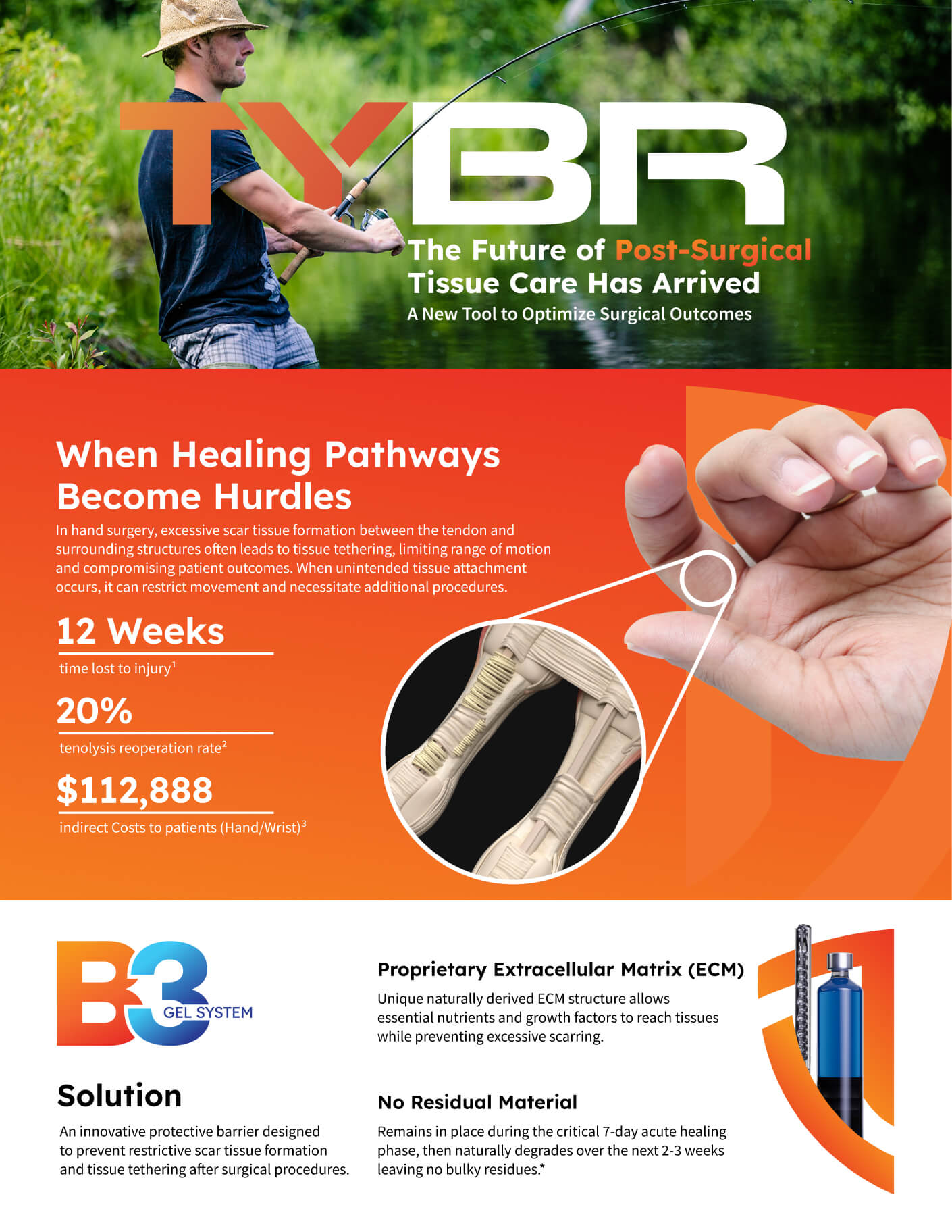
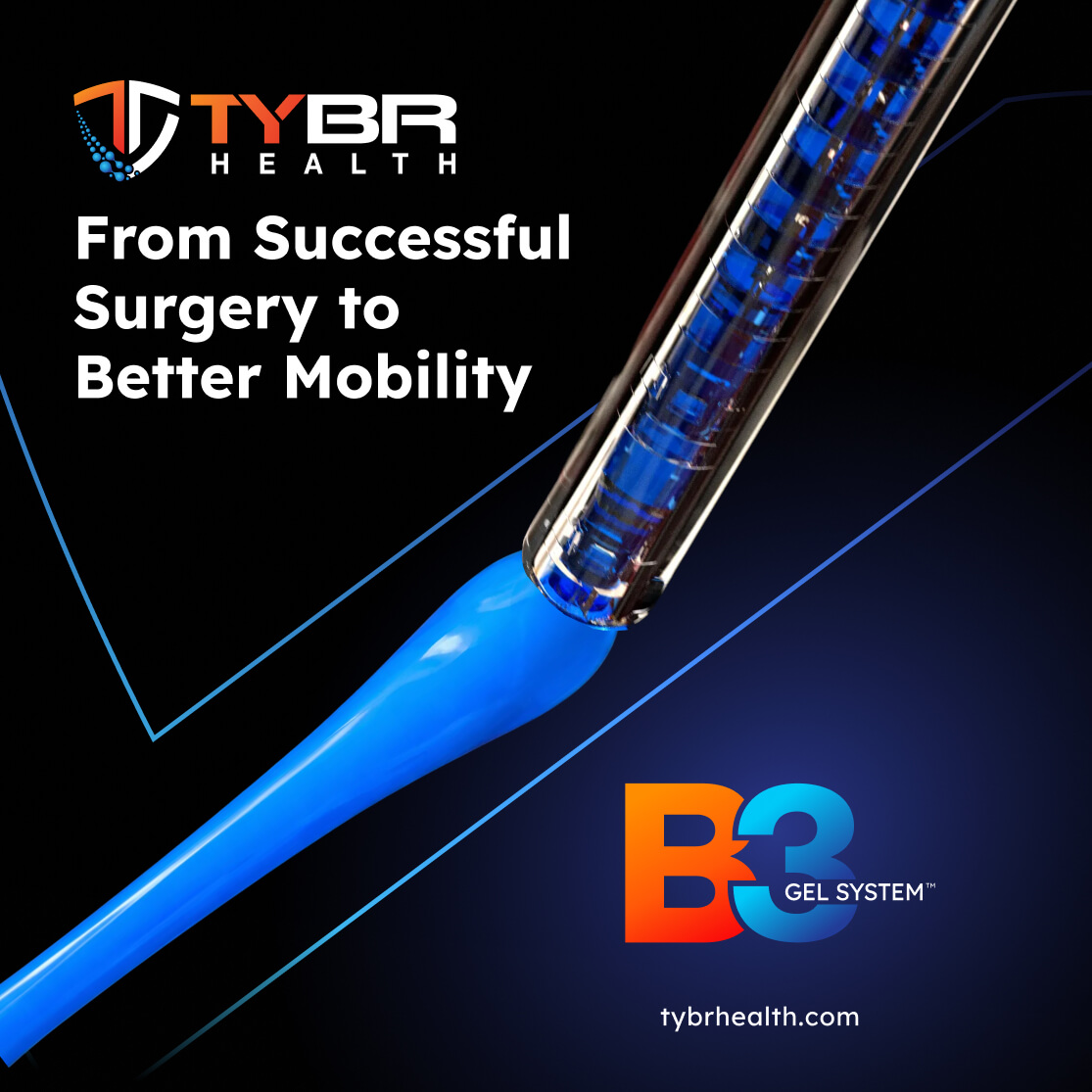
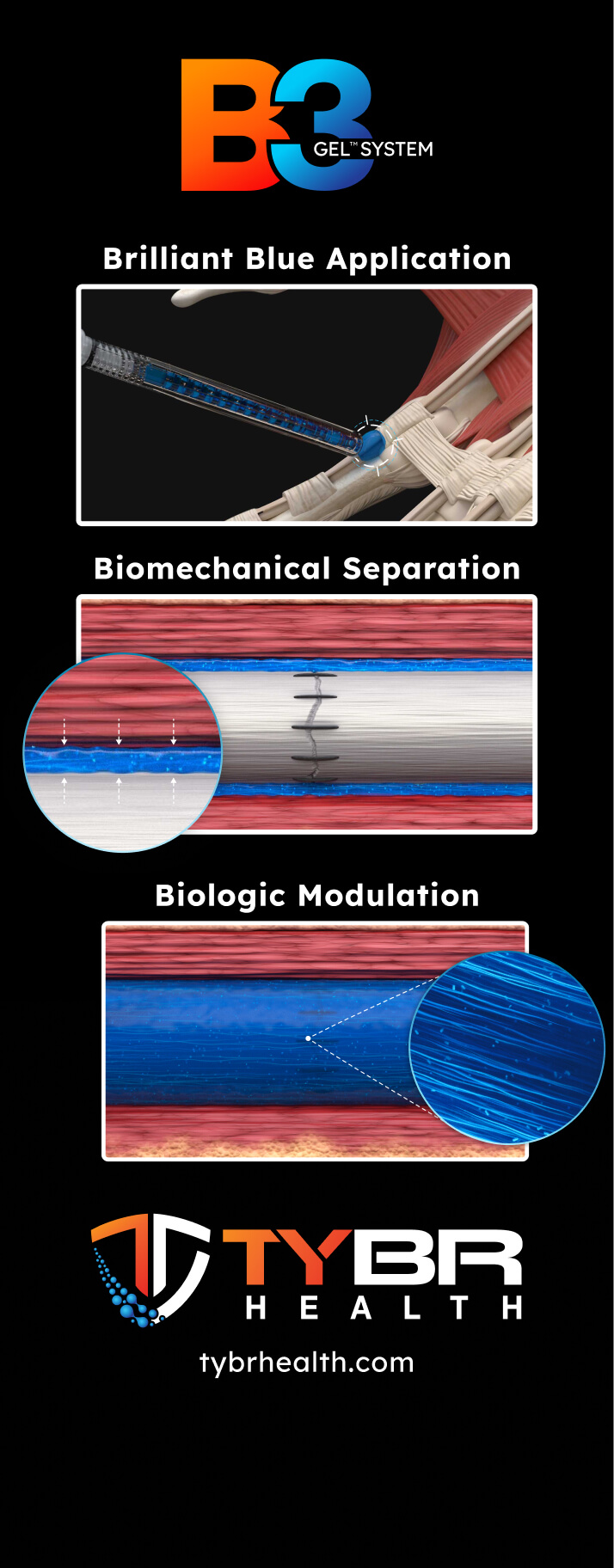
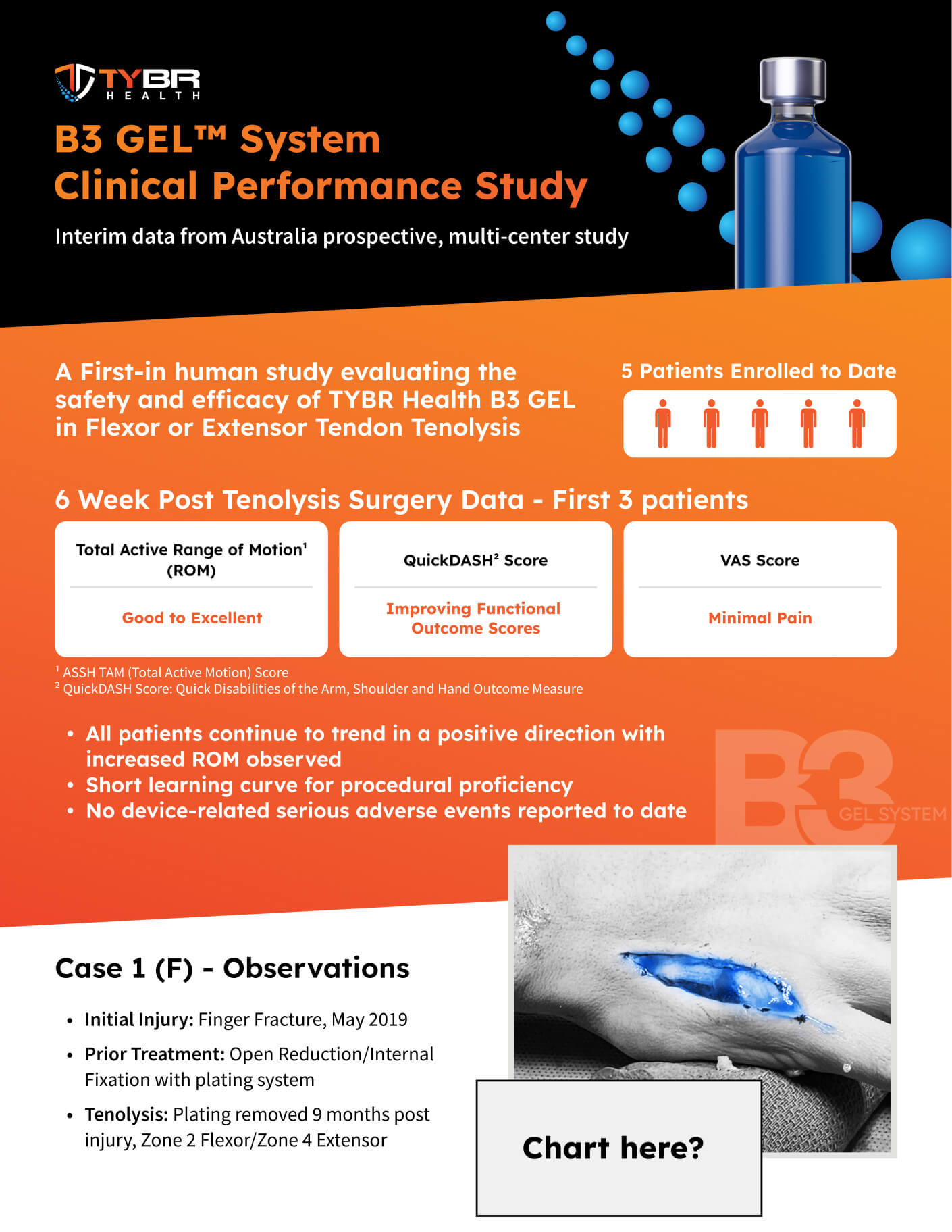
Selected pieces from the asset stack we built for TYBR Health post-FDA clearance, brand, web, MOA animation, sales materials, and campaign creative, all anchored on the same founder story.

07
Distribute and maintain
A canon built and forgotten is worth almost nothing. The real value compounds when the canon moves through the organization, reaches every channel in the version that's current, and stays fresh as the company changes.
The distribution problem
Most companies build a canon, dump it in a Dropbox folder, and pray. Six months later, half the team is working from an older version of the deck, the cold email templates haven't been updated, and the founder's podcast bio still has the original language from before the canon refresh.
The reason this happens is that a doc isn't a distribution system. It's a holding area. The canon doesn't compound until every piece of sales material, deck, sheet, animation, web page, rep talk track, is pulled from the same controlled source, with version control, and pushed out the moment anything changes.
Where the canon lives
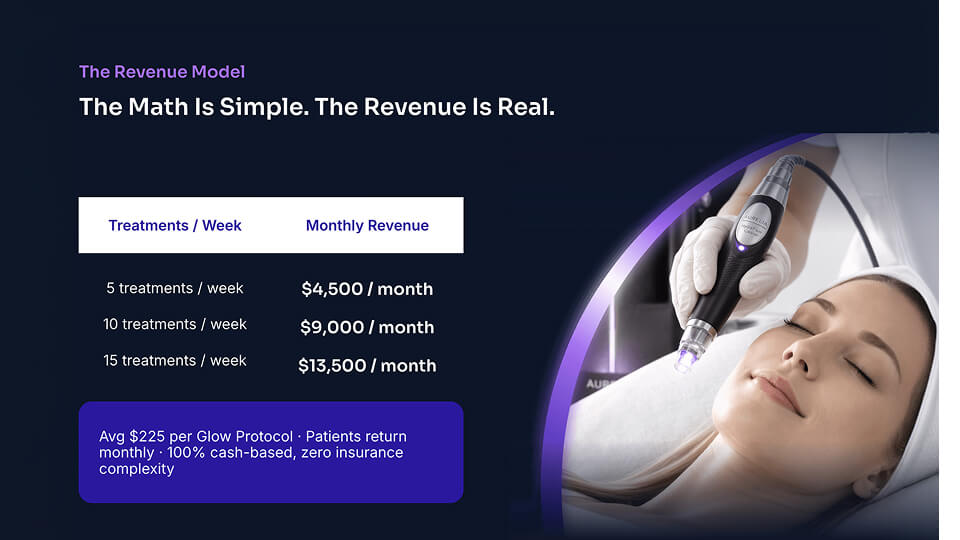
The canon needs a single controlled source of truth, not a doc-of-the-moment. For Vuelab clients, that source of truth lives in Nuvue, the platform we use to host, version, and distribute every canonical asset across the entire sales motion. The canon is the content. Nuvue is how it travels.
Nuvue is built specifically for this problem. The four canonical assets, the deck, the animation, the sales sheets, the rep talk tracks, all of it lives in one place, gets pushed to every channel automatically, and updates the moment the canon is refreshed.
Vuelab builds the canon and the assets. Nuvue makes sure they actually reach the people who need them, in the version that's current, every time.
hellonuvue.com / canon
Nuvue.
Canon
Publish
Source of truth
Aurelia
Introductions
Demo
Follow up
Meridian
One source of truth. Edit the canon once.
→
Every channel updates. Deck, website, email, podcast bio, booth.
Why distribution decides whether the canon works
A canon nobody can find is a canon that doesn't compound. The whole point of investing in the work is that every rep, marketer, and exec can grab the right asset for the touchpoint they're about to walk into, a cold email, a discovery call, an RFP, a conference booth, without DM-ing someone for the latest version.
That only happens if the canon lives on a platform built for distribution: organized by sales-cycle stage, searchable by audience, and versioned so when something is updated once, it's updated everywhere. A doc-of-the-moment can't do that. Neither can a Dropbox folder. Nuvue can, it's why we built it.
And it has to work on a phone
The most important moments in a sales cycle don't happen at a desk. They happen in a hallway between sessions at a conference, in a parking lot before a hospital visit, on the sideline of a kid's soccer game when a buyer texts back. If your distribution platform isn't mobile-responsive, half the value is gone.
×
Six ways this playbook fails
Most failures don't come from getting the steps wrong. They come from cutting corners on the steps that look easy.
Notes, rehearsal, a re-read of the deck the night before. All of it surfaces the polished version of the story you already had, which is the version that wasn't working. Tell founders to show up unprepared. It feels wrong; it's the right move.
The whole technique depends on follow-ups, silence, and gentle redirection when the founder drifts. Interviewers who treat the session as a podcast and let the founder steer get a transcript that reads like marketing copy. Push.
The rough lines are the real lines. Lines that read clean often read clean because the founder has rehearsed them, which means they came from somewhere else, not from the founder's actual thinking. Trust the awkwardness.
The temptation is to start designing as soon as the founder gets excited about the story. Resist it. Designing against a canon that's still moving means the deck, the animation, and the sales sheets will fight each other. Lock the canon first. Then design.
The company grows. The market shifts. The founder's language evolves. A canon written at Series Seed reads as quaint by Series B. Quarterly review is non-optional, and a full refresh after major milestones is worth the day it takes.
Sales teams will fill a vacuum. If there's no canon, reps will improvise. Some will be great. Some will be off-message. None of it compounds across the team. The canon's whole point is consistency, that's the asset.
Sharpen the story.
Sell the device.
This playbook is open on purpose, run it yourself if you have the team for it. If you'd rather not, that's the work we do.