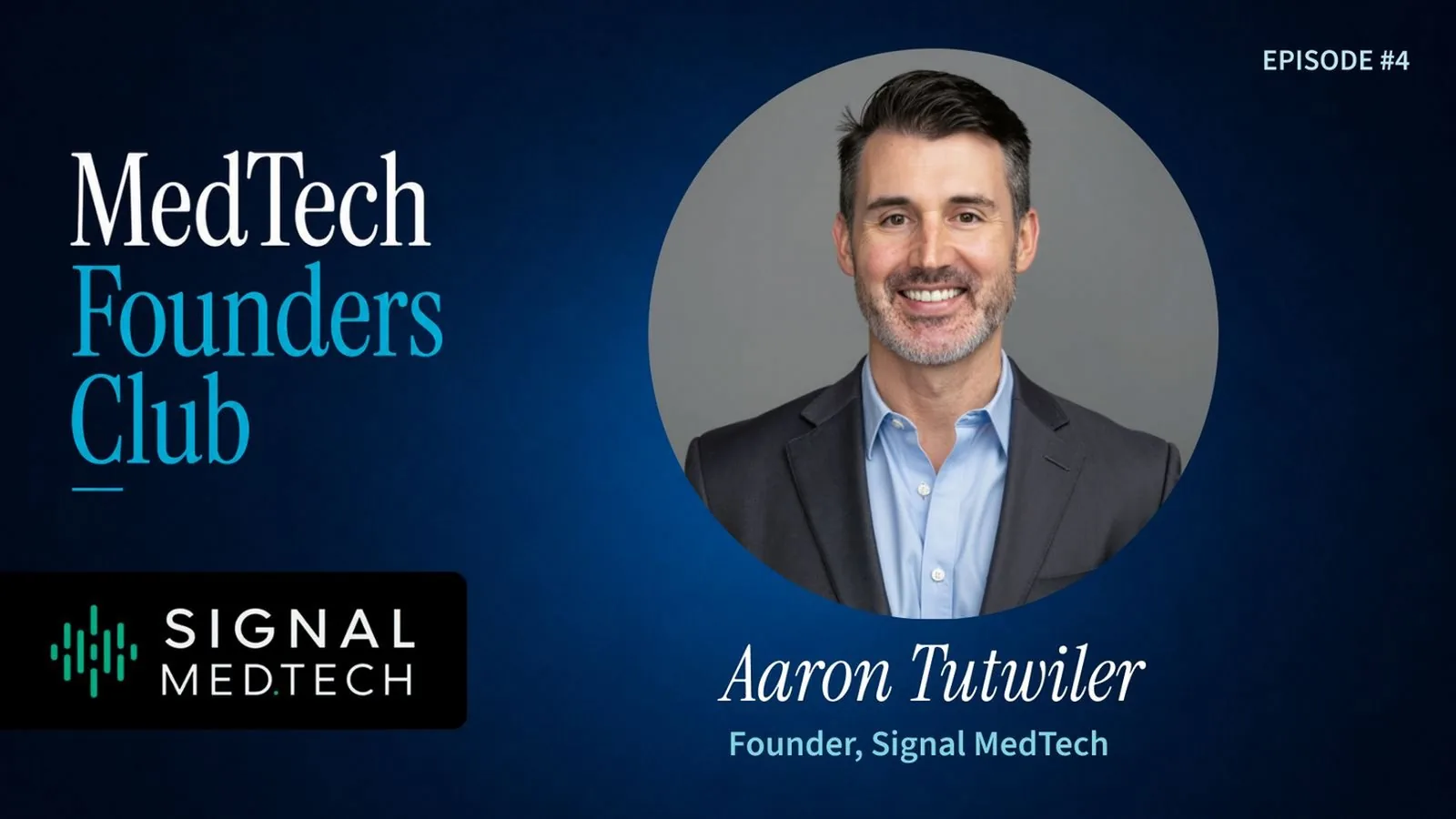
Aaron Tutwiler has spent twenty years in medtech, first at large public companies and then at early-stage startups, including one with a successful exit. Along the way he met many technical and clinical founders who understood their technology deeply but not what it takes to bring a device to market. That gap became Signal MedTech, a network of commercial operators who help founders with go-to-market strategy.
In this episode of the MedTech Founders Club, Aaron and Tim Dingersen walk through the five commercialization mistakes Aaron sees most often, and what founders can do instead.
Mistake 1: Building before validating the market gap
Founders fall in love with the technology before confirming anyone needs it. From inside the company, the market gap feels obvious. It rarely is. Aaron's first question in discovery calls is how much customer insight and market research a founder has captured, and too often the answer is none.
“The technology might be solving a problem, but nobody's willing to pay for it.”
His advice for first-time founders is an accelerator, a structured boot camp, often run by a university or investor, that forces you to talk to the people who would actually buy and use the product. He also mentors in the National Science Foundation's I-Corps program, where the entire first phase is market research. Learning early is far cheaper than learning two or three years and a lot of money later.
Mistake 2: Launching too broad
Pitch decks love to show millions of potential patients and billion-dollar markets. Experienced, sector-specific investors read that as a company that hasn't made up its mind. A broad launch dilutes the message, the team's effectiveness and the chance to win.
“Every account that you add before you have proven that gap just dilutes your signal.”
Aaron recommends narrowing to one specialty with the strongest clinical case, a region where you can physically be in the room, or an account type with a short approval process. The goal is not to prove the product can sell everywhere. It is to prove a real gap exists somewhere, with a message and a process you can repeat before you scale.
Mistake 3: Treating FDA clearance as the finish line
Clearance is a huge milestone, but it does only one thing: it tells the market you are allowed to sell. It says nothing about whether anyone will pay. Coverage, reimbursement and commercial planning are separate bodies of work that have to run in parallel.
“Getting that regulatory clearance is your license to go hunt.”
Aaron describes a surgeon founder who paused all commercial planning while the FDA process dragged on. When clearance finally came, nothing was ready, and the delay turned into another delay. Tim shared the opposite example: TYBR Health engaged Vuelab about a year before clearance, so distributors, sales materials, social and the website were all ready on day one.
Mistake 4: Skipping the story
First-time founders often go so deep into the science that they lose the room. They nail every detail of the mechanism of action, then look up at an audience that still doesn't understand the business or why it matters.
“If I can play a sixty-second animation of my technology so that everybody in the room can say, okay, I get it, now I can get into the numbers.”
Aaron points founders to Donald Miller's StoryBrand framework and to a simple test from Y Combinator: if your mother-in-law can't explain what you do to her friends, you don't understand it well enough yet. A short animation can take much of the explaining off a founder's shoulders, so the room sees the technology before the numbers. Tim added that messaging should keep evolving as you listen to customers.
Mistake 5: Scaling the sales team before the message is proven
After clearance, the board wants revenue, and the instinct is to hire fast. But five reps hired before you know what makes a buyer say yes are five people making the same mistakes. Aaron says your first commercial hire should be your most adaptable rep, not your most experienced one.
“If you can't tell me what objection killed your last three deals, then you're not ready to scale up yet.”
He also warns against building pilots only around famous key opinion leaders. They can make almost anything work. The real question is whether the average clinician can adopt the device, and simple tools like a quick-start procedure guide often decide that.
Aaron's advice for the day you get clearance
Treat clearance as permission to sell, not proof that anyone will buy. Spend the first ninety days proving that one narrow customer type will buy and that a specific payment pathway works, before you spend your capital on scaling. Founders who learn that in ninety days can fix it. The ones who learn it a year later are usually out of cash.
“Don't celebrate by scaling. Celebrate by going narrow, staying focused, and being super successful in a unique niche.”
Key takeaways
- Validate the market gap with real buyers before you build a company around the technology.
- Start narrow: one specialty, one region or one account type you can win.
- Run commercial planning in parallel with the regulatory process, not after it.
- Lead with the story. Show the technology simply, then get into the science and the numbers.
- Know which objections kill your deals before you hire more reps.